
UK Vape Tax 2026: How Vaping Products Duty Works From 1 October
By Univapez Team ·
For adults aged 18+ only. This article is for general information and does not provide medical or legal advice.
What Is the UK Vape Tax in 2026?
From 1 October 2026, the UK Government will introduce a new excise duty called Vaping Products Duty, commonly shortened to VPD.
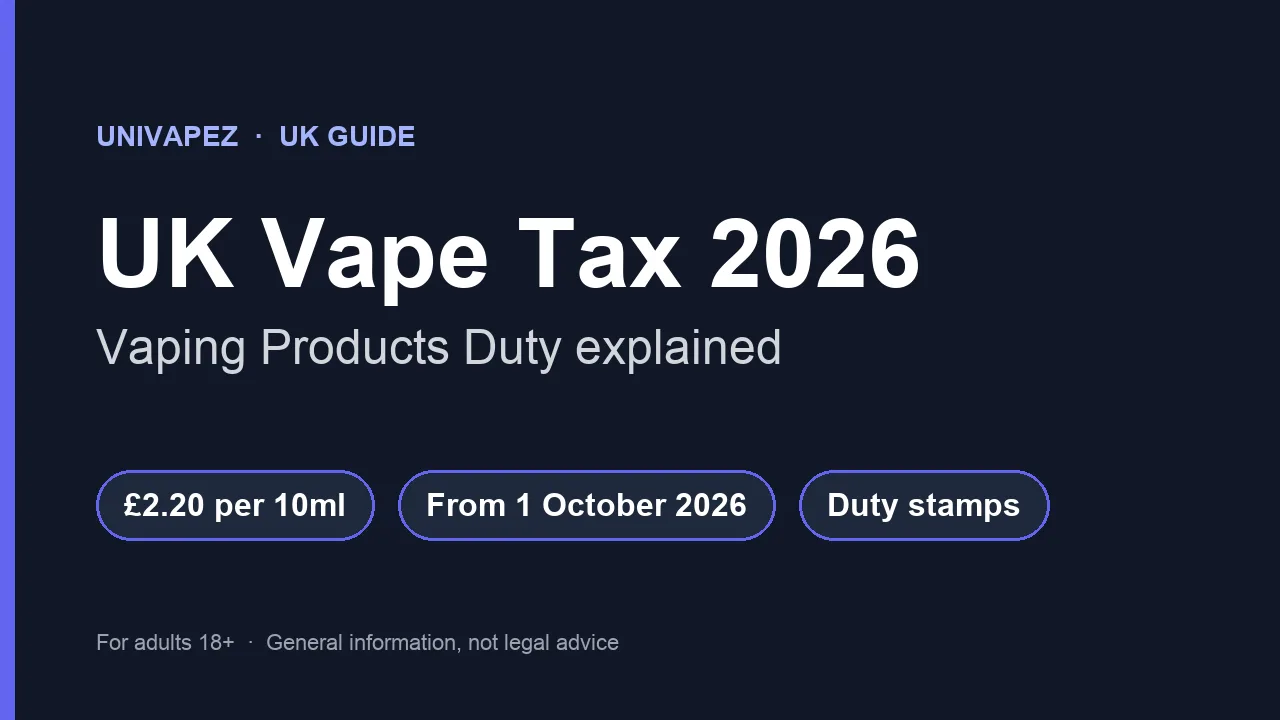
Under the new system, vaping liquid will be taxed at a flat rate of £2.20 per 10ml, which is equivalent to 22p per 1ml. The rate applies whether the vaping liquid contains nicotine or is nicotine-free.
This means the vape tax UK 2026 introduces a volume-based duty rather than a tax based on nicotine strength. A 10ml bottle containing nicotine and a 10ml nicotine-free vaping liquid are therefore subject to the same VPD rate if they fall within the scope of the duty.
Vaping Products Duty is being introduced alongside the Vaping Duty Stamps Scheme, which creates a new system for marking products intended for the UK market.
For customers, retailers and other businesses in the vaping supply chain, the main date to remember is 1 October 2026.
How Much Is Vaping Products Duty?
HMRC has set one flat rate: £2.20 per 10ml of vaping liquid. That works out at £0.22 per ml.
HMRC gives simple examples: a 2ml pod creates a VPD liability of 44p, while a 10ml refill bottle creates a VPD liability of £2.20.
The same calculation applies to other volumes of vaping liquid. Larger bottles and shortfills are still assessed according to the amount of vaping liquid they contain. The important point is that VPD is calculated from liquid volume, not puff count, device price or nicotine concentration.
The duty figure should also not automatically be read as the exact amount by which a retail price will change. Final product pricing remains a commercial decision for manufacturers, suppliers and retailers.
Does the Vape Tax Apply to Nicotine-Free E-Liquid?
Yes. One of the most important points about Vaping Products Duty is that it applies to vaping liquid regardless of whether it contains nicotine.
HMRC states that the £2.20 per 10ml rate applies to all vaping liquids, including nicotine-free products.
This means the new system is broader than rules that only focus on nicotine-containing products. For customers comparing e-liquids, nic salts, pre-filled pods or other vaping formats, the relevant VPD calculation is based primarily on the quantity of vaping liquid within the product.
When Does the UK Vape Tax Start?
The official start date for Vaping Products Duty is 1 October 2026.
Vaping products produced in or imported into the UK before that date are generally outside VPD liability. HMRC states that products manufactured or imported before 1 October 2026 are not treated as excise goods for VPD purposes.
That creates an important transition period. Retailers can continue selling eligible unstamped stock that was manufactured or imported before 1 October 2026 until 31 March 2027.
So shoppers may temporarily see a mixture of older unstamped stock and newer duty-stamped stock during the transition.
What Are Vaping Duty Stamps?
Vaping Products Duty and Vaping Duty Stamps are connected, but they are not the same thing.
VPD is the actual excise duty charged on vaping liquid. The Vaping Duty Stamps Scheme is a compliance system used to identify products entering the UK market under the new duty regime.
From 1 October 2026, liable vaping products released onto the UK market must carry an appropriate duty stamp. HMRC describes these as secure physical stamps attached to the outer retail packaging. Digital versions include a scannable code that can support authentication and supply-chain tracking.
The stamp should therefore not be interpreted as a medical, safety or quality approval. Its purpose is related to tax and supply-chain compliance.
What Happens Between October 2026 and April 2027?
The transition is important because not every unstamped vape product becomes unlawful on 1 October.
HMRC allows retailers and wholesalers to continue selling qualifying unstamped products that were manufactured or imported before 1 October 2026 until 31 March 2027.
The key timeline is:
- 1 October 2026: Vaping Products Duty begins and new liable products released onto the UK market must follow the duty-stamp requirements.
- 1 January 2027: Only digital duty stamps can be newly affixed under the transition timetable.
- 1 April 2027: All vaping products outside duty suspension that are sold or supplied in the UK must carry a valid vaping duty stamp.
After 1 April 2027, retailers cannot simply continue selling old unstamped stock.
Who Actually Pays Vaping Products Duty?
VPD is primarily a business-side excise duty.
Manufacturers and importers may have responsibility for accounting for the duty depending on how vaping products enter the UK market and when the duty point occurs.
Importers generally need to account for VPD when vaping products arrive in the UK unless those goods immediately enter an approved duty-suspension arrangement.
Retailers that only sell or distribute vaping products on which the relevant duty has already been dealt with do not need to apply for VPD or Vaping Duty Stamps Scheme approval. They do, however, need to make sure the products they purchase and sell comply with the new requirements.
For customers, there is no separate HMRC vape-tax payment to submit when purchasing a product from a retailer.
What Could the Vape Tax Mean for 2ml Pods and 10ml E-Liquid?
The simplest way to understand the new system is to think in terms of liquid volume.
A 2ml pre-filled pod carries 44p of Vaping Products Duty under HMRC's published rate. A 10ml e-liquid bottle carries £2.20 of VPD.
Larger vaping-liquid formats are assessed using the same 22p-per-ml calculation. That means the duty applies consistently across different vaping formats rather than being based on branding, claimed puff count or nicotine concentration.
Customers looking at vape pods, nic salts and other e-liquid formats may therefore start noticing duty-stamped packaging appearing as the new regime takes effect.
Will Every Vape Product Cost More From 1 October?
Not necessarily on the same day and not necessarily by exactly the headline duty amount.
There are several reasons. First, retailers can continue selling qualifying older stock produced or imported before 1 October 2026 during the transition period. Second, manufacturers, wholesalers and retailers each make their own commercial pricing decisions. Third, different products contain different volumes of vaping liquid, which means the underlying VPD amount varies according to volume.
Because of this, it would be misleading to claim that every product will rise by one fixed amount on 1 October. The factual position is that newly liable vaping liquid becomes subject to VPD at £2.20 per 10ml from that date.
Does Vaping Products Duty Replace Existing Vape Regulations?
No. Vaping Products Duty is a tax measure. It does not replace the UK's existing product, packaging or other regulatory requirements for vaping products.
It is also separate from the UK ban on single-use vapes that took effect on 1 June 2025.
A product can therefore have several different regulatory considerations, including whether its format is legally reusable, whether it meets applicable product rules, and whether VPD and duty-stamp requirements apply.
This is why terms such as VPD UK, reusable vape rules and duty stamps should not be treated as interchangeable.
What Should Customers Look For After 1 October 2026?
During the transition, seeing an unstamped product does not automatically mean it is non-compliant. Eligible products produced or imported before 1 October 2026 can continue to be sold unstamped until 31 March 2027.
For newly duty-liable stock, however, the duty stamp becomes an important part of the retail packaging requirements.
By 1 April 2027, all vaping products sold or supplied in the UK outside duty-suspension arrangements must carry a valid vaping duty stamp.
Customers should avoid assuming that the presence of a stamp says anything about whether a product is healthier, safer or better than another product. It is fundamentally an excise-duty and compliance marker.
Key Takeaway
The vape tax UK 2026 introduces a major change to the way vaping products are taxed in the UK.
From 1 October 2026, Vaping Products Duty will apply at £2.20 per 10ml of vaping liquid, including nicotine-free vaping liquids.
At the same time, the Vaping Duty Stamps Scheme begins for newly liable products entering the market. Older eligible stock gets a temporary transition period, but from 1 April 2027, vaping products sold or supplied in the UK will generally need a valid duty stamp.
For customers, the most useful approach is to focus on accurate product information, understand that duty is calculated according to liquid volume, and expect packaging and pricing to evolve as the new system is introduced.
Browse e-liquids · View nic salts · View compatible vape pods
Frequently Asked Questions
When does the UK vape tax start?
Vaping Products Duty starts on 1 October 2026.
How much is the vape tax in the UK?
The rate is £2.20 per 10ml, equivalent to 22p per ml.
Does Vaping Products Duty apply to nicotine-free vape liquid?
Yes. HMRC states that VPD applies to vaping liquid whether or not it contains nicotine.
What is the tax on a 2ml vape pod?
At the published VPD rate, 2ml of vaping liquid creates a duty liability of 44p.
Can retailers still sell unstamped vapes after 1 October 2026?
Yes, but only qualifying older stock produced or imported before 1 October 2026 can continue to be sold unstamped during the grace period ending 31 March 2027.
Are duty stamps proof that a vape is safe or high quality?
No. Duty stamps are part of the UK tax and supply-chain compliance system. They should not be treated as a health or quality endorsement.
Sources
- GOV.UK / HMRC – How to pay Vaping Products Duty
- GOV.UK / HMRC – How Vaping Duty Stamps work
- GOV.UK / HMRC – Handling wholesale or retail vaping products in the UK
- GOV.UK / HMRC – Importing and exporting vaping products
- GOV.UK – Introduction of Vaping Products Duty from 1 October 2026
- GOV.UK – Single-use vapes ban
Like this? Tell Google you want more of it.